This is told like a great nineteenth century Russian novel, so it's a bit longer than usual. The protagonist (occasionally me) is a professor in his early 50's. As the last of his students leaves his dark study, one young beautiful man, Dmitri, remains. The professor gazes at him and somehow they end up making love. This of course is totally illegal. Outside in the snow, a massive bearded man with an impossibly wide back, his head tiny in proportion, returns to his apartment - for this study is his room. Strange, he thinks, he can hear no music from within: Dmitri must be sleeping. Quietly he unlocks the front door with its folding inner panel, and then enters his flat. We next hear such shouting and then cut to an interior view where Dmitri, an older and darker man, hurls the professor from the bedroom into the cold. The poor man stands in -20 degrees with no shoes and socks on. "How can I travel to my conference tomorrow?" he sobs.There is some confusion in the narrative here because he is now standing on the booted feet of young Dmitri, his arms around him. "I love you, Dmitri. You can never love me, but I just want you to be my fancy man."After the commotion the author, a sensitive woman, appears in a walk-on role as a waitress. She leaves a small bill in neat handwriting for the flan that was consumed, adding as an aside, "Here I used one of my favourite french flans."
 Thora Hird is recounting all the episodes of her life for a video. She talks us through the loves and disappointments behind the plays she performed in . It is an Everyman story in a way. She relates it calmly, and occasionally the tears well up in her eyes. "I won't cry ," she says, "I just want to tell the story as it is." But a few tears escape as she narrates the last chapter.
 We are discussing something about thinking patterns. I have a disagreement with one of the women who thinks the only good decisions about the future must contain a negative rule - like "Don't do ..." I don't think negative statements help anyone but she stops me from getting too argumentative. Enclosed within transparent flaps of a box we clink glasses. June shows us the drawing she has just quietly made depicting us walking out of a circular pathway. On the exit path are the words "JUNG, WILL, ME , I."
 It is the end of a conference in a large European city. I am with redhaired Alma and a large friendly man. I am keen to say goodbye to blonde Alma with whom I have spent a lot of time. She tells me I have some red hot issues to deal with here because I am still in love with X. She gives me a book of short stories she has written - one is particularly relevant. I return to the others."Look Blonde Alma gave me her book," I say. "Or did you write it?" I ask Red Alma. The man laughs - "I wrote it!" "But it has to be written by a woman and its all about Alma - look at the bit about Alma pudding! and all that stuff about her young lover!" "So happy you liked it," he says.(had completely forgotten I had any knowledge at all of Alma pudding but there it is in Mrs Beeton's cookbook)
 There is a vague memory of an earlier complex dream about a young man. Now we see the workings behind this dream. Two wise women vie for the strongest influence over the man's actions - both have blazing auras down the sides of their bodies, one is white, the other a lurid green.
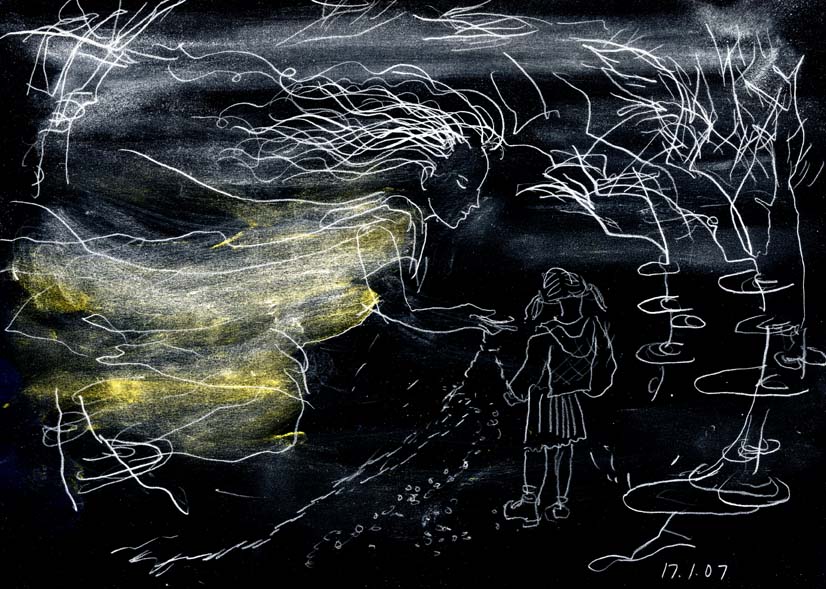
 A number of fairy stories started in the Nazi era. They were created for children running from persecution to help them understand the notion of escape and overcome their fear. Here a flying woman guides little Red Riding Hood through the forest of Manderlay.